Our Revamped Syllabus and Education Structure
The Australian Cadet Corps is excited to announce the launch of our revamped syllabus and education structure, designed to give cadets a clearer, more rewarding pathway through their learning journey. This update, made possible by Education Commander Lars Hulin, makes our education system more structured, engaging, and recognisable – both within the Corps and beyond.
“Our new syllabus consolidates previous courses, expands the corps educational horizons and embeds leadership training. “
Education Commander, Commander Lars Hulin
How It Works?
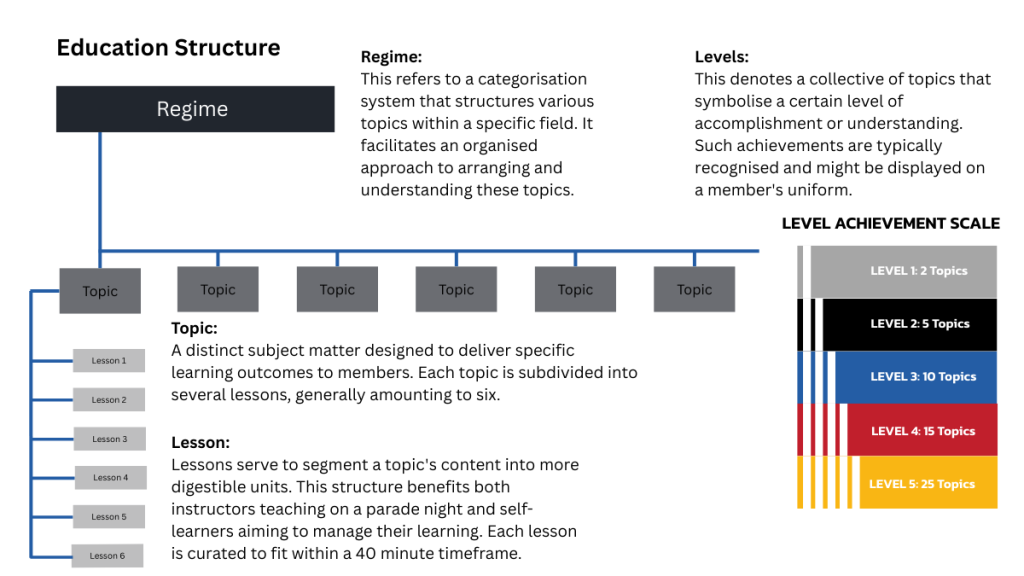
The system is built on four layers of learning:
- Regimes – broad categories of study (e.g. Aviation, Community, Creative).
- Levels – milestones achieved by completing a set number of topics within a regime.
- Topics – subject units, each consisting of around six lessons.
- Lessons – 40-minute sessions designed for either parade nights or self-study.
This structure means cadets can progress step by step, building expertise across areas that interest them, while instructors can deliver material in manageable, engaging chunks.
The Seven Regimes
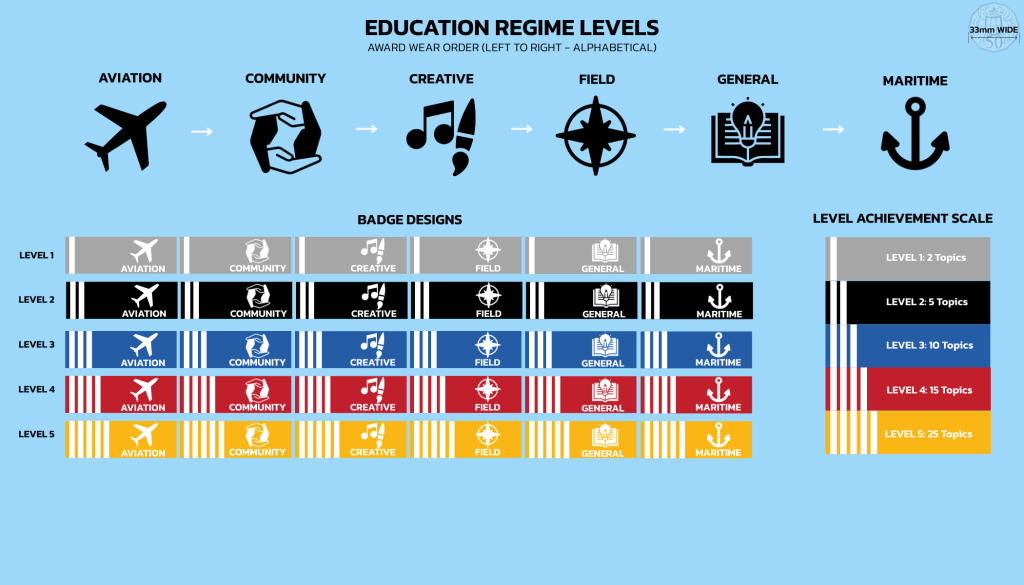
Each regime has five levels, with cadets earning a certificate and a distinctive uniform badge as they progress. Badges feature regime-specific icons, with level indicated by coloured backgrounds and white stripes.
- Aviation (AVI): Exploring the mechanics of flight, aircraft design, aviation history, and modern aerodynamics.
- Community (COM): Focused on service and community safety, with topics designed to prepare cadets to contribute meaningfully to society.
- Creative (CRT): Developing cadets’ artistic and expressive skills through a range of creative disciplines.
- Field (FLD): Building resilience, discipline, and teamwork through outdoor and survival skills.
- General (GEN): Covering broad knowledge areas not tied to a specific regime, ensuring a rounded education.
- Maritime (MRT): Equipping cadets with skills and knowledge related to the sea, navigation, and marine life.
Leadership (LDR): Dedicated to developing cadets as leaders.
Progression and Recognition
Cadets progress through five levels in each regime:
- Level 1: 2 topics
- Level 2: 5 topics
- Level 3: 10 topics
- Level 4: 15 topics
- Level 5: 25 topics
Each level is recognised with a Certificate of Achievement and a Uniform Pin, proudly worn above the left breast pocket. Those who complete all topics in a regime may apply for Mastery Level, a distinction that marks true expertise in that field.
The Leadership Training Program (LTP)
Youth Leadership Training
The LTP is structured in progressive stages, aligned with cadet development and rank progression:
LTP 1 – Foundations of Leadership: Teamwork, communication, following instructions, and understanding the chain of command.
LTP 2 – Leading Peers: Responsibility for small groups, discipline, mentoring basics, and setting an example.
LTP 3 – Junior NCO Development: Training in drill instruction, event organisation, and effective use of authority.
LTP 4 – Senior NCO Leadership: Broader responsibilities including planning, managing junior cadets, conflict resolution, and safeguarding awareness.
LTP 5 – Officer Preparation: Transitioning from NCO to officer roles, covering governance, child safety, duty of care, and the responsibilities of command.
These stages ensure cadets not only grow as individuals but also develop the confidence and responsibility to lead effectively within their units.
Officer Training
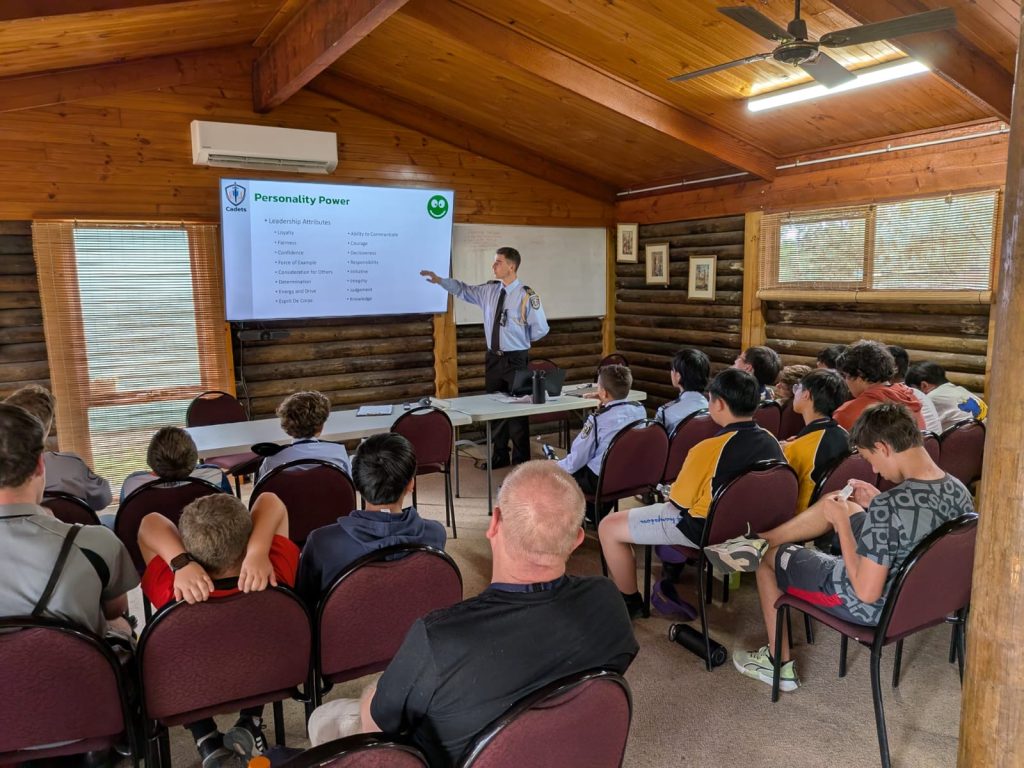
For those moving into officer roles, additional officer training modules are in place. These focus on advanced leadership, child safety, governance, and operational planning. Combined with the LTP, officer training ensures that our leaders are fully prepared for the unique responsibilities of command within the Corps.
Why This Matters
This new education structure gives cadets clear pathways for achievement, a wider range of subjects to explore, and recognition for their progress at every step. More importantly, it reflects the values of the Corps: discipline, service, creativity, resilience, and leadership.
The revamped syllabus marks a fresh chapter in cadet training — one that equips our members not only for success within the Corps, but also for life beyond it.